Morgan Peters · 20 September 2026
Hidden Microclimates Drive Insect Community Dynamics in Fragmented Heathland Areas
Fragmented heathland patches create pockets where temperature, humidity, and wind patterns differ sharply from surrounding landscapes, and these variations directly influence which insects can persist and reproduce. Researchers tracking soil surface temperatures across isolated heathland remnants have recorded differences of up to 4 degrees Celsius within distances of only 15 meters, while moisture levels fluctuate enough to alter plant growth cycles that many insect species rely on for food and shelter.
Microclimate Formation in Heathland Fragments
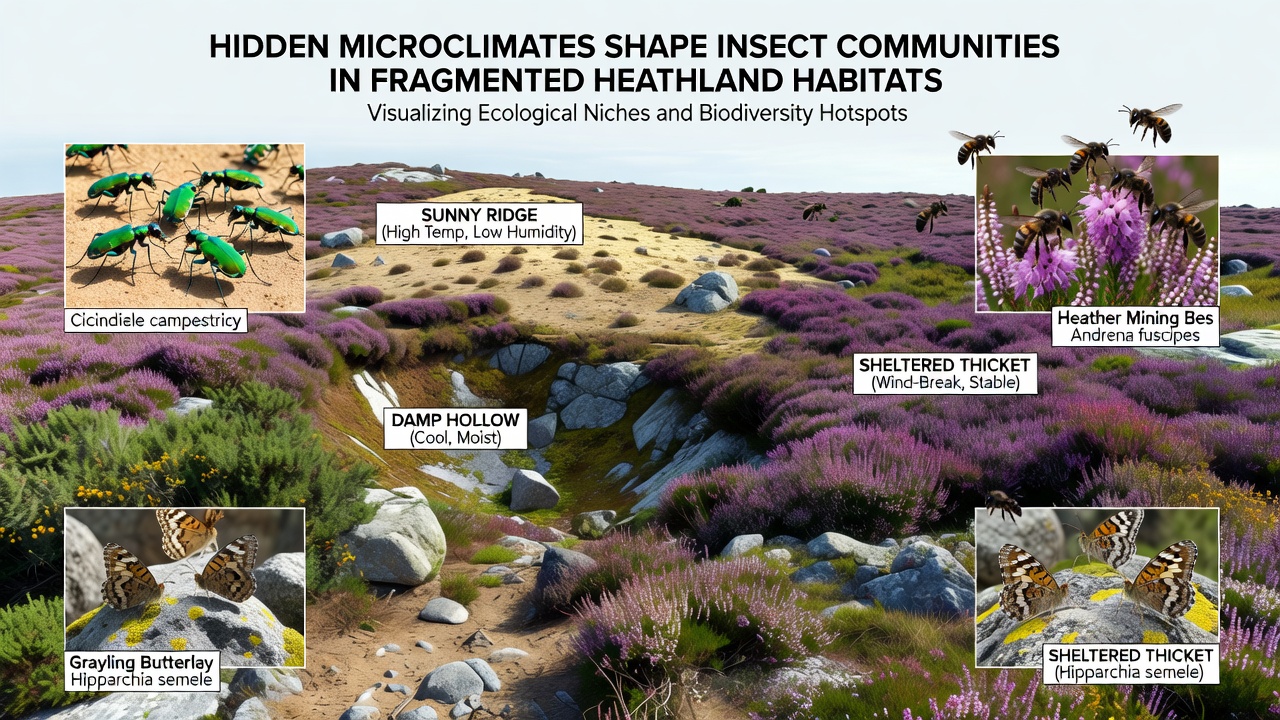
Vegetation structure, slope orientation, and soil depth combine to generate these localized conditions, and observers note that north-facing slopes often retain higher humidity while south-facing areas experience greater daily temperature swings. Data collected from sensor arrays deployed in European heathland sites show that even small changes in canopy cover produce measurable shifts in ground-level microclimates that affect egg-laying success for ground-dwelling beetles and the larval survival rates of certain moths. Because fragmentation increases edge exposure, wind speeds rise near patch boundaries and accelerate evaporation, which in turn reduces the suitability of those zones for moisture-dependent species such as springtails and certain parasitic wasps.
Effects on Insect Species Distribution
Insect communities respond to these gradients through shifts in abundance rather than outright extinction in many cases, and studies indicate that generalist pollinators often concentrate in warmer, drier micro-sites while specialist herbivores remain restricted to cooler, moister interiors. Long-term monitoring programs have documented that butterfly species with narrow thermal tolerances move toward shaded depressions within larger fragments during summer months, whereas beetles adapted to open ground occupy the hotter edges. These patterns emerge consistently across multiple study areas, suggesting that microclimate availability functions as a key filter determining local diversity levels.
Fragment size further modulates these effects because smaller patches contain fewer internal microclimate types, and surveys reveal lower overall insect richness in remnants under two hectares compared with those exceeding ten hectares. Soil compaction from recreational use or grazing adds another layer by altering heat retention and drainage, which compounds the challenges for burrowing insects. Researchers have measured reduced emergence rates of solitary bees in compacted zones where surface temperatures exceed optimal thresholds for nest provisioning.
Research Findings and Monitoring Data
Evidence from multi-year field studies shows that microclimate heterogeneity supports higher functional diversity among insects even when total species counts remain moderate, and this functional variety helps maintain pollination and decomposition processes within the fragments. One investigation covering heathland sites in several countries found that patches with greater topographic relief sustained more stable insect populations during drought periods because shaded pockets retained usable moisture longer. Such findings align with broader biodiversity assessments that link habitat structural complexity to resilience against climate variability.
Continued data collection through 2026 has refined these observations, with automated loggers now capturing hourly variations that earlier manual sampling missed. The expanded datasets confirm that edge effects penetrate farther into small fragments than previously estimated, altering microclimate conditions across most of the available area in patches under one hectare. Conservation groups tracking these trends use the information to prioritize restoration actions such as creating internal shelter belts that recreate cooler, moister zones within existing fragments.
Implications for Habitat Management
Management approaches that preserve or enhance microclimate diversity include selective cutting to maintain varied vegetation heights, and targeted reintroduction of grazing animals at low densities that create a mosaic of short and tall patches. These practices increase the number of available thermal and humidity niches without requiring large-scale land acquisition. Organizations such as the European Biodiversity Information System compile records from multiple regions that demonstrate how such interventions correlate with improved insect persistence in fragmented settings. Similar approaches appear in reports from the Natural Resources Canada forest biodiversity program, where microclimate considerations guide restoration in analogous open habitats.
Conclusion
Hidden microclimates therefore act as critical determinants of insect community composition in heathland fragments, and the evidence accumulated to date underscores the value of incorporating microclimate mapping into routine habitat assessments. Continued monitoring will clarify how these localized conditions interact with broader climate trends, while management strategies that deliberately sustain microclimate variety offer a practical route to supporting insect populations across increasingly divided landscapes.